doncoleman.ca
I wanted a site I owned outright, that was cheaper and simpler to run, with room for consulting work.
- Agentic development
- Web
- Static sites
Problem
My site ran on Ghost, hosted on Magic Pages, with Flux, a theme I built myself. The AI reading features ran separately on Supabase. It worked, and I enjoyed building on Ghost, but the site was spread across two hosted services and none of it lived in one place I controlled.
I was also starting to think about consulting work. That meant project stories like this one, a contact form and a page about working with me. All of those were possible in a Ghost theme, but awkward enough that I kept putting them off.
So the goal was easy to say: put the content, the design and the hosting in one repository I own, run it more cheaply and simply than before, and make room for the consulting side of the site.
Options
Before choosing anything, I wrote down what the new site had to do.
- Agents know the stack: I planned to have AI agents do most of the building, so I wanted tools they already know well. Otherwise I’d spend my days correcting them.
- Static by default: Pages are built ahead of time and served as plain files, which is fast, cheap and hard to break.
- Under $13 a month: The whole site, including the small APIs, had to stay under that.
- Keeps the Flux look: I liked the design I’d built and wanted the site to still look like mine.
| Option | Agents know the stack | Static by default | Under $13 a month | Keeps the Flux look |
|---|---|---|---|---|
| Stay on Ghost with Flux | Partly | No | No | Yes |
| Astro on GitHub Pages or Vercel | Yes | Yes | Partly | Yes |
| Astro on Cloudflare WorkersChosen | Yes | Yes | Yes | Yes |
Why Cloudflare Workers won: it serves the static pages and runs the small APIs on one free plan. Staying on Ghost kept the look but failed on cost and on static pages. Astro on GitHub Pages or Vercel got most of the way there, but the contact form and the AI questions would have needed a second service again, which is what I was trying to get away from.
Build
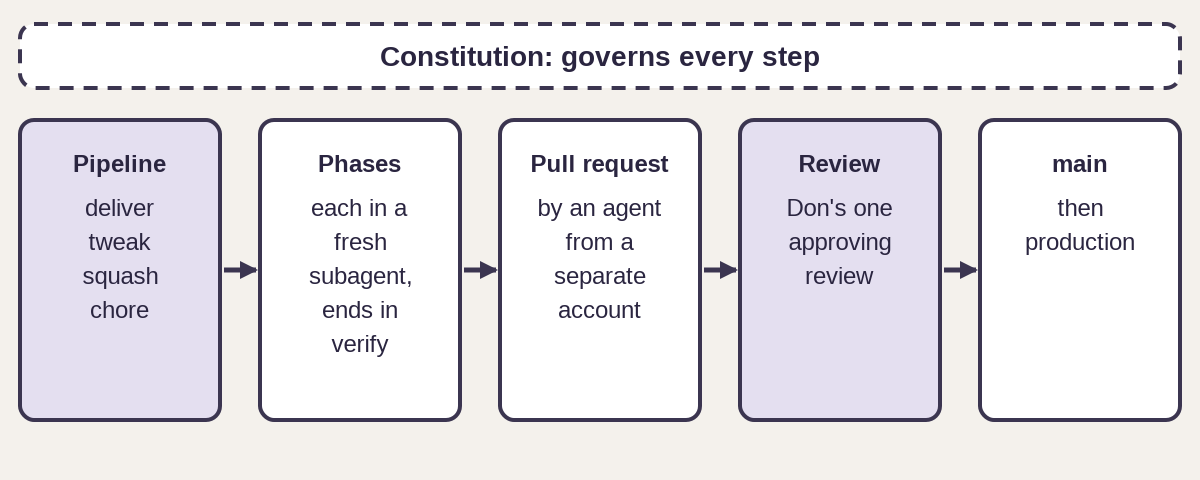
Most of this site was built by AI agents, with me reviewing every change. I didn’t want to just chat with an assistant and paste code around, so I set up a process.
Every change goes through one of four pipelines, depending on the kind of change: /deliver for a new feature, /tweak for a small visible change, /squash for a bug and /chore for maintenance. A pipeline breaks the work into phases (spec, plan, tests, build) and hands each phase to a fresh agent. That keeps each agent focused on one job instead of carrying one long, muddled conversation. I built the first three for Cadence and brought them over. /chore is new here, for work that changes nothing a reader would see.
Over all of it sits a constitution, a short set of principles every phase has to follow. It wins whenever a plan disagrees with it. Tests come first. Contact messages are emailed to me and never stored. It’s already on version 4.0.0, which tells you how often I’ve had to amend it.
Nothing merges without my approval. GitHub won’t let you approve your own pull request, so the agents open theirs from a separate account and I review as myself. Once I approve and the tests pass, the change merges and deploys on its own.
The hardest part turned out to be the test run every change has to pass. Early on it took about 31 minutes in CI. I also run several agents at once, each in its own copy of the repository, and on my machine they fought over the same ports and failed whenever it was busy. Getting CI down to about 6 minutes took three things: testing each behaviour at the cheapest level that can catch it, building test fixtures once instead of over and over, and splitting the run into jobs that run side by side.
The result is the site you’re reading: static pages built by Astro, served from Cloudflare Workers, with the contact form and AI questions running in the same Worker.
Lessons
I learned to be picky about tests. Early on, the agents wrote a lot of tests that just restated configuration. They took time to run and never caught anything. Pruning them, and checking the real content instead, left a smaller suite that’s more useful.
Speed matters more than I expected. Making the test run five times faster did more for how much I could ship than any single feature.
Agents will happily overcomplicate things. I had to keep working at it to keep decisions pragmatic and the testing focused on what’s important.
I’m still working out where the line sits between what the agents decide and what I decide. For a personal site, one approval per change feels about right. Whether that holds up for a team is the question I’m most curious about.